
Adolescence Rewards One Rewatch, but Not Four Full Episodes
Netflix’s one-take drama reveals more in the custody process and the psychologist’s room. A selective rewatch gives you the craft without repeating the whole series.
Streaming · August 11, 2026 · 8 min read
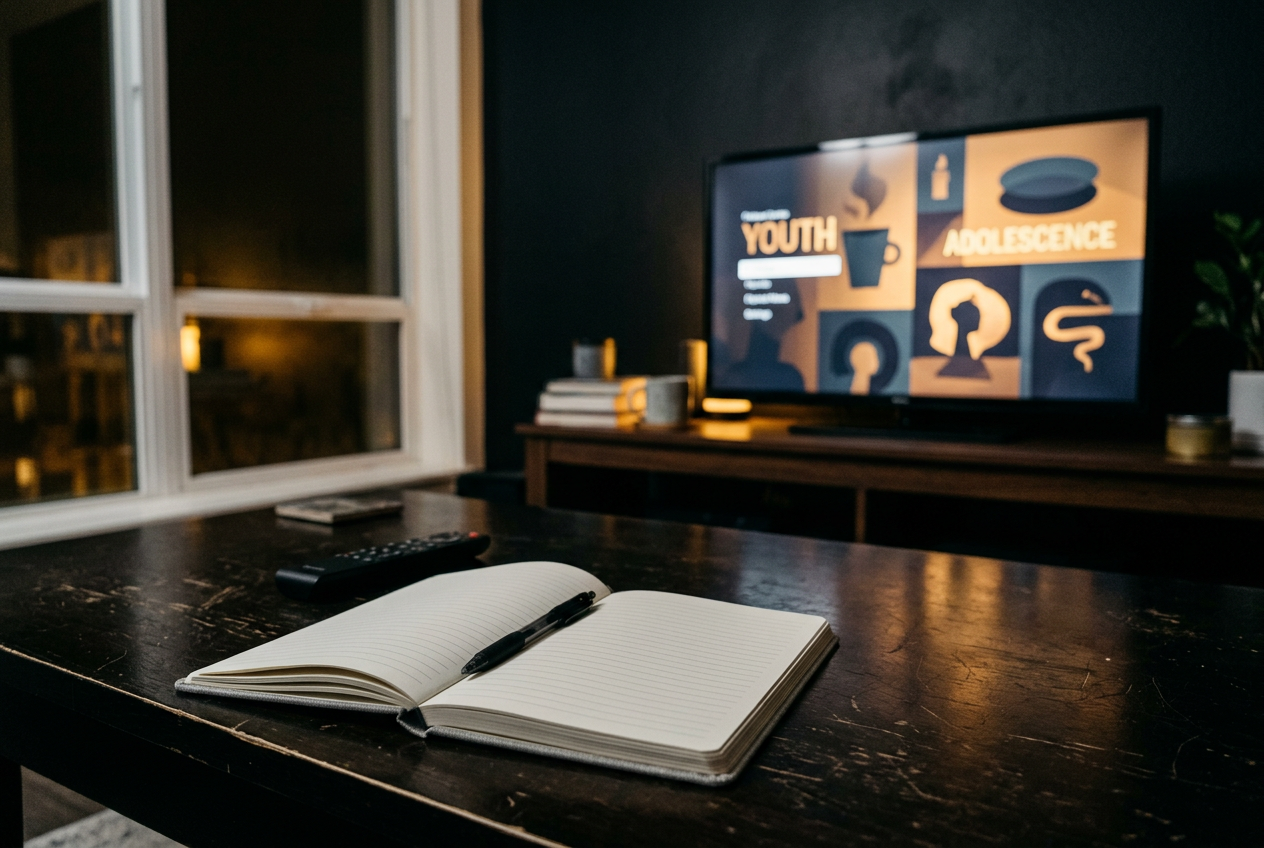
This is streaming coverage, and the practical answer matters more than admiration for the production feat: Netflix’s four-part limited series asks for another evening if replayed from beginning to end, while much of its strongest rewatch value sits inside two episodes and several shorter passages.
The opening section stays safe for viewers who have not finished. Detailed spoilers begin after the next subhead.
Adolescence builds each episode as a continuous take, meaning the action plays without an editorial cut resetting time or viewpoint. That design creates immediate pressure on a first watch. It also makes ordinary television behavior, including checking a phone or letting dialogue run while making dinner, unusually costly. Information can enter through a doorway, remain at the edge of the frame and disappear without a close-up telling you to save it.
The concrete test is episode one’s police-station passage. Jamie Miller moves through booking, consultation and interview while adults repeatedly decide where he stands, who may touch him and which version of events counts. On first viewing, the sequence works as escalation toward the video evidence shown near the end. On a return, the procedures and physical separations become the story rather than its route to the story.
That difference explains why some of Adolescence deserves another look. The one-take format can hide meaning inside tension, but it can also make viewers admire a difficult camera move that says little beyond how difficult it was.
Spoilers begin with the custody sequence
Episode one’s closing revelation changes every denial that came before it. Once the surveillance footage has shown Jamie killing Katie, a rewatch no longer treats the station as a place where innocence might be established. It becomes a chamber in which Jamie tests language, proximity and parental faith even though the central fact is already fixed.
Watch the custody passage rather than chasing supposed clues in every corner. Blocking, the planned placement and movement of performers within a scene, shows Jamie being transferred among systems that use different tones but reach the same destination. Police officers direct his body. The solicitor controls when he answers.
His father Eddie tries to preserve their familiar relationship while sitting inside a room whose rules belong to someone else. Jamie can protest, withdraw or seek reassurance, yet he cannot control the sequence of doors.
The camera supports that reading without announcing it. A camera handoff, when one operator passes the rig to another so the shot can continue through a difficult transition, lets the episode cross vehicles, corridors and rooms while preserving real-time momentum. These transfers are worth noticing, especially where the frame changes height or settles after squeezing through a threshold. They explain how the episode was made.
They do not all deepen Jamie’s character.
The more useful detail is where the camera arrives after each transition. It sometimes reaches a room before Jamie has found his place in it, allowing institutional routine to continue around the person experiencing the worst day of his life. At other moments it stays close enough to trap the viewer within his panic. The movement keeps changing the balance between seeing Jamie as a frightened child and seeing the evidence that the adults must process.
Return to the final video after replaying the station material. Its force comes partly from a sudden change in visual authority: the episode has spent almost its entire running time attached to people who can plead, misread and protect one another, then an impersonal image settles what happened. That is genuine added meaning. Spotting the precise doorway where the camera changed hands is craft appreciation, valuable in its own lane but not a reason to replay the whole hour.
Episode two turns the school into an information system
The second episode spreads attention across a school where students understand the social context faster than the investigating adults. Its continuous movement lets conversations overlap and keeps pupils active behind the official inquiry, so a first viewing can feel like trying to follow one urgent exchange in a building that refuses to quiet down.
A selective return clarifies the episode’s argument about information. The police can enter classrooms and ask direct questions, but authority does not grant fluency in the codes students use. DI Luke Bascombe’s son helps explain the meanings attached to online symbols and the hostility surrounding Jamie. That explanation gives the investigation a vocabulary it lacked; it also exposes how much the adults failed to see before a death forced them to look.
Background movement matters here more than hidden plot evidence. Students watch the police, relay reactions and adjust their behavior according to who is nearby. The camera cannot cut to every response, so the viewer chooses where to look, which is precisely how the school defeats the adults trying to read it. Attention has limits.
Adolescence turns that limit into form.
Still, episode two offers diminishing returns as a full replay. Once the social codes have been explained and the routes through the school are familiar, several long transitions remain transitions. The real-time walk preserves confusion on first viewing, while a second pass can make the structure feel like a friend who stayed after the useful part of the conversation had ended. Revisit the school arrival, the explanation involving Bascombe’s son and the exchanges around Katie’s peers.
The connective travel mostly demonstrates coordination.
Episode three earns the closest return
Episode three places Jamie across from psychologist Briony Ariston months after the killing and removes most of the logistical spectacle. The episode still unfolds in one take, but the central problem has changed. There are fewer corridors to conquer. The camera has to register control moving across a room as Jamie alternates between charm, inquiry, evasion and anger.
This is the episode most improved by a complete rewatch. First-watch tension concentrates on whether Jamie will erupt and what he might disclose. Once that uncertainty has gone, smaller negotiations come forward: where each person sits, how long Briony permits silence, when Jamie seeks approval and how quickly an apparently casual question becomes a demand. His concern with how she sees him carries more weight when the destination of the conversation is known.
The food and drink in the room also stop looking like incidental realism. They belong to a controlled environment designed to appear less severe than an interview room, yet Jamie keeps testing whether care means affection, preference or power. Briony offers professional attention without giving him the personal validation he wants. The mismatch narrows the space long before his body does.
Here, the one-take design adds meaning because neither participant receives relief through editing. A conventional version could cut to a reaction shot, meaning a separate image used to show how someone receives another person’s words, and thereby tell the audience which emotional shift matters. Adolescence makes Briony manage her face while Jamie watches it. The viewer must do the same work he is doing, though with a clearer sense of the threat behind his scrutiny.
Camera technique becomes less showy and more exact. Gradual changes in distance matter because the episode has established the room’s boundaries; a step forward can alter the balance without needing a new angle. Rewatching the full exchange preserves those accumulations. Jumping straight to Jamie’s outburst would reduce a behavioral study to the loudest evidence.
This episode also settles the larger rewatch argument. Adolescence gains most when its continuous time reveals how power shifts through behavior. It gains less when continuous time mainly connects one complicated location to another.
The family finale needs its ending, not a full replay
Episode four follows Jamie’s family after the case has reorganized daily life around them. The call in which Jamie says he will plead guilty gives the episode its unavoidable fact, while Eddie’s return to his son’s bedroom turns that fact into parental grief. The family cannot maintain a theory of mistaken accusation after Jamie abandons it himself.
A second viewing can sharpen how strain passes among Eddie, Manda and Lisa, particularly when an ordinary family outing keeps colliding with public knowledge of the crime. Yet the episode hides less than the first three. Its pain comes from duration and recognition rather than from information missed under suspense. Once the plea and bedroom ending are known, replaying every movement does not substantially revise them.
The final bedroom scene is the useful return. Eddie’s apology to Jamie’s teddy bear compresses everything the series has withheld from him: access to his son, certainty about where responsibility began and any chance to repeat the years that formed Jamie. The continuous shot denies him an escape from the room, though the scene would retain much of its meaning under conventional editing. Performance carries the weight.
Technique protects the time around it.
That distinction keeps the one-take design in proportion. The finale needs patience, but patience and rewatch value are different claims.
The efficient rewatch starts with three, then one
For viewers returning primarily for meaning, start with episode three in full. Follow it with episode one, paying closest attention from the arrest through the custody process and then replaying the surveillance reveal. Episode two works in selected school passages. Episode four can be reduced to Jamie’s call and Eddie’s time in the bedroom without losing the main benefit of hindsight.
This order breaks chronology on purpose. A rewatch no longer needs to preserve the murder mystery, and episode three provides the clearest lens for Jamie’s methods of seeking control. Episode one then shows earlier versions of those methods under panic. The later family material lands without requiring another complete circuit through the day.
Use a television rather than a phone if the goal is background blocking. No premium setup is required, but a larger frame makes it easier to watch the edge of the school corridors without losing the speaking character. Subtitles can help with overlapping dialogue, although reading them may pull attention away from the very background behavior being revisited. One useful compromise is to replay dense exchanges once with subtitles and once without them.
A full four-episode rewatch remains defensible for viewers interested in live staging, operator movement and the endurance required from the cast. For everyone else, it asks for several near-hour blocks while yielding uneven returns. Episode three changes under scrutiny. Episode one reorganizes itself after the reveal.
The remaining episodes contain scenes worth revisiting, but their connective tissue has already done its job.
Questions people ask
Does Adolescence need a full rewatch?
No. Episodes one and three gain the most from hindsight because the custody process and psychological interview contain behavior that first-watch tension can obscure. Selected passages from episodes two and four provide most of their additional value without committing to the complete four-part run again.
Which episode of Adolescence is best to rewatch?
Episode three benefits most from a complete return. Knowing where Jamie’s interview with Briony leads shifts attention toward his changes in posture, his requests for validation and her management of silence, all of which accumulate across the uninterrupted conversation rather than residing in one reveal.
Does the one-take format hide extra plot clues?
It hides fewer secret clues than it hides competing behavior. Background pupils in episode two and procedural activity in episode one can be missed, but the main facts become explicit. The richer second-watch material concerns who controls a room, where people are positioned and how attention moves before dialogue catches up.
Can selected scenes show how the camera handoffs work?
Yes. Episode one’s transitions through vehicles, station corridors and interview spaces provide the clearest examples, while episode two demonstrates how the camera crosses a crowded school. Watch the frame’s height and stability around thresholds, then notice where it settles; those passages reveal the engineering without requiring another full-series commitment.
One update a day
Today's review, in your inbox
One review each morning — no hype, no filler, just what is worth watching.


