
The Odyssey IMAX Seat Map Favors Rows Behind the Middle
A tall IMAX screen rewards immersion but punishes a poor seat. Start just behind the auditorium midpoint, then move back if neck strain or motion discomfort matters.
Cinema · August 11, 2026 · 8 min read
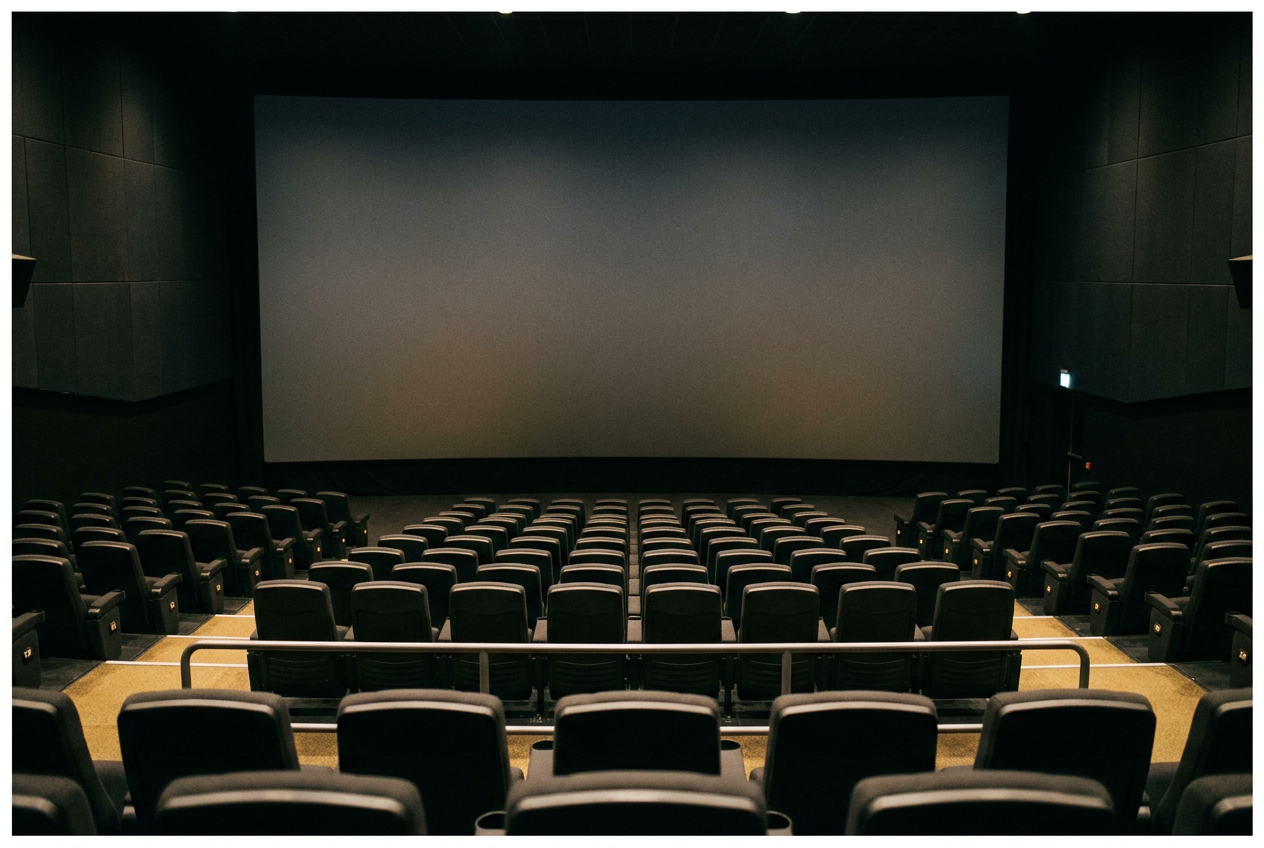
This is cinema coverage and contains no plot spoilers. The Odyssey has not been evaluated here as a finished film; this is a booking guide built around the demands of Nolan’s established large-format compositions and the geometry of tall IMAX auditoriums.
The concrete test is the top edge. From your seat, look at the center of the blank screen with your head level, then register whether you can take in its upper boundary by moving only your eyes. If finding that edge requires lifting your chin, a full-height image will ask for repeated head movement once the frame becomes busy.
That matters in an IMAX auditorium capable of showing a 1.43:1 image, an aspect ratio describing a frame only moderately wider than it is tall, because the screen occupies much more vertical vision than the wide rectangles used by most multiplex presentations. Christopher Nolan’s earlier large-format films have used changes in image height to distinguish IMAX material, allowing the frame to open above and below without treating that added space as disposable decoration.
A conventional seat recommendation often points toward the center of the auditorium. For Nolan at full IMAX height, shift that answer back a little.
Read the auditorium before reading the row letters
Seat maps disguise distance. A theater may label its first public row D because unused letters cover the space nearest the screen, while another may interrupt the middle with an accessible platform or a cross-aisle. Counting letters therefore tells you less than dividing the occupied seating area into front, middle, and rear thirds.
Start with the horizontal centerline. Nolan’s large-format frames can place a face, vehicle, horizon, or architectural line away from the middle, but the central seat keeps the screen’s left and right edges at equal angles, which reduces the amount of eye and head travel needed to inspect the composition. Moving one or two seats sideways is usually a smaller compromise than moving several rows forward.
Next, establish what the theater means by IMAX. A 1.90:1 IMAX presentation is taller than common widescreen cinema but less vertically imposing than 1.43:1.
A listing for 70mm may refer to conventional 70mm film rather than IMAX 15/70, the large film format that runs 15 perforations across each frame. Ask the venue whether the advertised show uses its full-height 1.43:1 screen and whether the presentation is IMAX film or a projector capable of filling that screen.
The distinction changes the seat calculation. In a 1.90 auditorium, the middle rows can provide a strong sense of scale without forcing the top edge far into peripheral vision, meaning the outer area seen without looking directly at it. On a steep 1.
43 screen, the same relative row can feel closer because the picture extends much farther upward.
The front third turns composition into scanning
The front third offers the strongest impression of size, yet that scale comes from placing parts of the image outside the area a viewer can inspect comfortably in one glance. When the top-edge test demands a chin lift before the feature begins, full-height material is likely to divide attention between the center of action and the upper frame.
That can work for a viewer seeking physical immersion, particularly when a shot holds long enough for the eye to travel through it. It becomes harder during rapid movement or cutting. A close object crossing the screen covers more of the viewer’s vision, while a cut from a broad landscape to a face forces the eyes to reacquire scale and position; the composition remains intact on the screen, but the seat prevents it from being perceived at once.
Nolan’s images do not always direct attention with shallow focus or an obvious central subject. Large-format photography can preserve detail across broad planes, letting foreground figures and distant structures share the frame, and a front seat turns that intended simultaneity into a sequence of separate observations. You see the lower action, scan upward, then return to the face or object carrying the cut.
The sound can compound the effect. Near-screen seats are not automatically the acoustic center of an auditorium, and powerful low-frequency effects may feel more prominent there even when dialogue remains intelligible. Anyone who already finds camera movement disorienting should treat the first third as a poor premium purchase. The image is bigger.
Access to the image is worse.
If the front third contains the only remaining seats for a full-height screening, a later show from a better row is the sensible alternative. A standard 70mm presentation may also preserve film texture and a bright, detailed image without asking the viewer to manage the same vertical expanse, although the exact available formats will depend on the theater.
The middle works after its first few rows
The middle third is where scale and legibility begin to cooperate. Its front rows still produce a dominant screen, especially in an auditorium with steep stadium seating, but the top-edge test becomes more useful here: the right seat lets your eyes find the upper frame while your head remains neutral.
For a first booking, aim around three-fifths to two-thirds of the way from the screen to the back wall, measured across actual seating rows rather than the letters shown on the map. Stay within a few seats of the horizontal center. This position is far enough back to read an expanded composition as a whole, yet close enough that the shift to a taller image remains perceptible rather than looking like a modest change in framing.
That balance matters more than maximizing raw screen coverage. In Nolan’s previous IMAX presentations, the opening of the frame can alter where visual weight sits: additional sky may increase isolation, added floor or foreground may clarify distance, and a vertically arranged group can become easier to read. The centered seat just behind the midpoint lets those relationships register without requiring a deliberate scan from top to bottom.
Recliners complicate the map. A seat that tilts the torso while supporting the head can make a nearer row tolerable, although an aggressive headrest may angle the face downward and recreate the strain. Fixed seats in older purpose-built IMAX rooms often sit on a steeper rake, meaning the floor rises sharply from row to row, which improves sightlines without reducing the screen’s vertical angle.
Use the blank-screen check rather than assuming newer seating solves the problem. Sit naturally. Look forward. If your chin rises to see the top edge, move back.
The rear third favors comfort over impact
The first few rows of the rear third are the safest choice for viewers prone to neck strain, headaches triggered by visual effort, or discomfort during fast screen movement. The full frame should fit more readily within vision, and the center of the screen will sit closer to a neutral head position.
This is not the same as choosing the last row. At the extreme rear, the architecture of a very large auditorium can become visible around the image, reducing the sense that the frame extends beyond ordinary theatrical scale. Projection booths, railings, entry lights, or the heads of late arrivals may also intrude more readily, depending on the room.
Choose the front half of the rear third and remain centered. That recommendation gives up some enveloping effect, but it preserves the reason to pay for a tall presentation: seeing how the complete frame organizes action at full size. A premium ticket loses its value when physical discomfort makes a viewer look away or brace against the seat during movement.
Viewers sensitive to motion should also avoid aisle seats far from center. An off-axis position makes one side of the screen appear larger and closer than the other, which can intensify lateral movement and turn straight architectural lines into a more skewed view. If easy access is necessary, favor the inner aisle of a central seating block rather than the auditorium wall.
A booking method that survives different seat maps
First, confirm the presentation. Look for specific language indicating IMAX 70mm or a full-height 1.43:1 digital show rather than assuming every IMAX listing uses the same frame. If the listing is unclear, contact the theater; the answer affects both the image and the row you should tolerate.
Then count occupied rows from the screen to the back and ignore their letters. Mark the point just behind halfway, keep to the central block, and use that as the default. For a viewer with no particular sensitivity who wants the image to dominate, move forward no more than a couple of rows. For neck or motion concerns, move backward into the opening rows of the rear third.
Finally, inspect the seat map for a cross-aisle. The row immediately behind one often offers unobstructed sightlines, yet it can sit farther from the previous row than the map suggests, creating a useful comfort zone without retreating to the back wall. Wheelchair spaces and companion seats may also alter row depth, so count physical distance rather than neat bands on the booking screen.
The top edge remains the check. If a theater permits entry before the feature and comparable seats remain available for another performance, use the trailers to assess your posture rather than enduring a full film from a punishing row. For The Odyssey, the practical target is centered, slightly behind middle. Comfort-sensitive viewers should go one zone farther back.
Questions people ask
Where is the best place to sit for The Odyssey in IMAX?
Start in the horizontal center, around three-fifths to two-thirds of the way from the screen to the rear wall. That position should preserve the impact of a tall IMAX composition while allowing the upper edge of the frame to remain visible without repeated chin movement.
Should
I book the front row for a more immersive IMAX experience?
The front row maximizes scale but can turn full-height compositions into material that must be scanned. If seeing the top edge of the blank screen requires lifting your chin, book farther back; the premium format is more useful when the entire composition remains readable.
Is 70mm the same as IMAX 70mm?
No. Conventional 70mm and IMAX 15/70 use different film transport and frame arrangements, and a theater advertising 70mm may not be offering a full-height IMAX image. Check the exact format with the venue before using a tall-screen seating recommendation.
Which
IMAX rows are safest for neck strain or motion discomfort?
Choose centered seats in the first half of the rear third, avoiding the extreme side aisles. This reduces the vertical viewing angle and makes rapid movement easier to follow, while retaining more large-format impact than the final rows at the back of the auditorium.
One update a day
Today's review, in your inbox
One review each morning — no hype, no filler, just what is worth watching.


