An IMAX Ticket Doesn't Tell You Which IMAX You're Getting
IMAX, 70mm, laser, and large format describe different parts of a presentation. This checklist shows what to verify before a premium ticket reaches checkout.
Cinema · August 11, 2026 · 8 min read
This is cinema coverage, and the useful unit is one showtime rather than a theater chain’s general promise. Take the booking decision that surrounded Oppenheimer: the Trinity test was built around scale, changing image dimensions, darkness, and a soundtrack whose impact depends partly on a room being able to move from near-silence to force without turning the sound brittle. A ticket marked “IMAX” told you less about that experience than many checkout pages appeared to suggest.
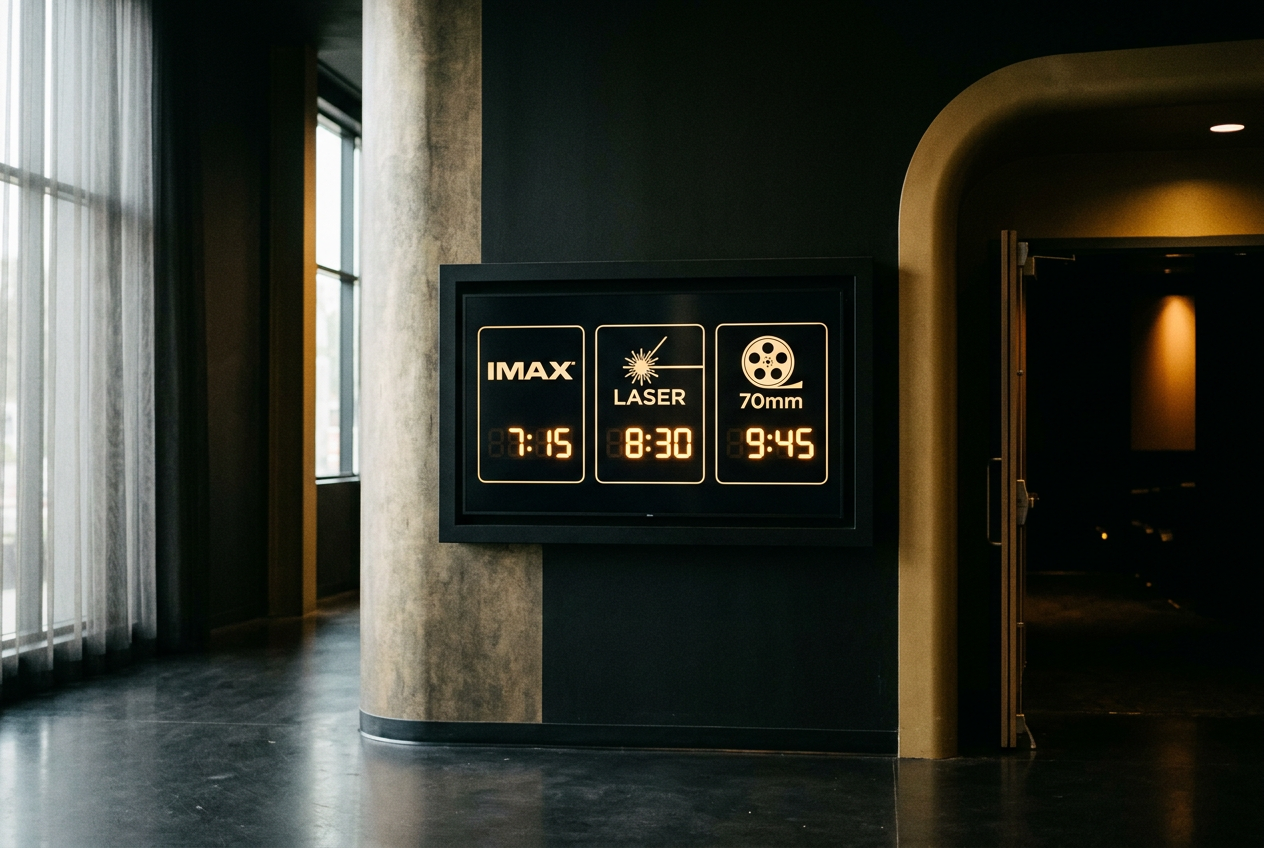
The same problem follows any film promoted around premium presentation. “IMAX,” “70mm,” “laser,” and “premium large format,” meaning an exhibitor’s category for an upgraded auditorium, do not describe the same thing. One identifies a branded presentation system. Another may identify a film print.
A third names the projector’s light source. The last can be a chain-specific bundle with no universal technical standard.
Treat those words as clues, not conclusions.
Start with the exact showtime, not the theater name
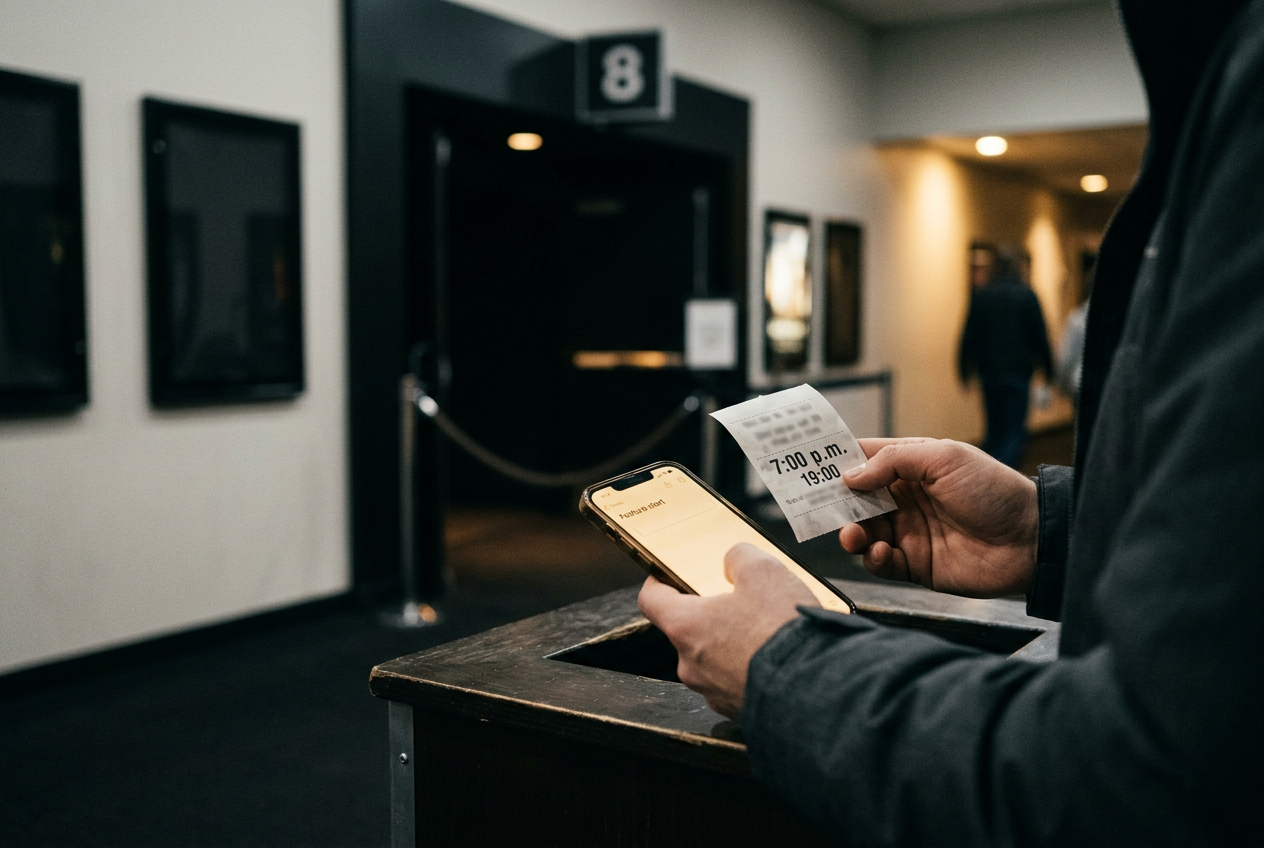
A venue can contain several auditoriums with different screens and projection systems, so confirming that a building “has IMAX” is only the first step. Open the individual showtime and copy its complete format label before comparing prices. “IMAX 70mm,” “IMAX with Laser,” “70mm,” and plain “IMAX” are materially different claims; if the listing shortens the name once it reaches the payment screen, take a screenshot of the earlier page.
Use the exhibitor’s own listing before relying on a ticket aggregator. Aggregators are convenient for schedules, but the venue controls the room and can clarify whether a generic label has swallowed a more specific format. A film’s official format page or distributor announcement can provide another check when special prints are limited to selected theaters, though those lists still do not settle which auditorium a particular showtime occupies.
For the Trinity sequence, this first pass separates a potentially distinctive presentation from a surcharge with unclear benefits. “IMAX 70mm” makes a specific claim about film projection. Plain “IMAX” does not tell you whether the source is film or digital, whether digital projection uses laser or an older xenon lamp, or how tall the picture can become.
Read every format word literally
IMAX is a branded exhibition system that combines approved projection, screen geometry, and sound, but installations differ. The name alone does not identify the projector generation, the screen’s dimensions, or the tallest aspect ratio the auditorium can display. Aspect ratio means the relationship between an image’s width and height; a lower first number, such as 1.43:1 rather than 1.
90:1, produces a taller image at the same width.
Some films contain sequences formatted to expand vertically in compatible IMAX presentations. That expansion depends on the movie, the delivered version, the projector, and the screen. A tall screen cannot create image information absent from the film, while a compatible file cannot fill a 1.43:1 frame if the room or projection system does not support that presentation.
“Laser” means the projector uses a laser-based light source rather than a lamp. It may bring stronger brightness and contrast, especially on a large screen, but the word does not establish screen size, aspect ratio, or whether the theater uses a single-projector or dual-projector setup. A generic “laser” badge also does not mean IMAX unless the listing says so.
“70mm” needs the closest reading. Conventional 70mm usually refers to a film print projected horizontally in a 2.20:1 image. IMAX 70mm, often called 15/70 because each frame uses 15 perforations, runs film through the projector in a different orientation and can support the much taller 1.
43:1 frame. A standard 70mm ticket is not an abbreviated IMAX 70mm ticket.
That distinction mattered around Oppenheimer. A viewer choosing conventional 70mm could still be choosing an event presentation on film, with the texture and mechanical character that entails, but not the same frame geometry offered by a compatible IMAX 70mm engagement.
Verify the room that your ticket opens
Seat maps tempt buyers to estimate screen size from the number of rows. They are weak evidence. A deep auditorium may have a modest screen, a renovated room may retain an odd seating plan, and the diagram may be schematic rather than measured.
Ask the venue for the auditorium number attached to the showtime, then request confirmation of the screen and projector in that room. The most useful wording is specific without demanding that a box-office employee recite an equipment manual:
Please confirm that this showtime is in the IMAX auditorium, whether it is projected from IMAX 70mm film or digitally, whether digital projection is laser, and whether the presentation can display the film’s 1.43:1 or 1.90:1 IMAX sections.
Call during a quieter part of the day if possible, or use the venue’s published contact channel. If the first person cannot confirm the equipment, ask whether a projection manager or venue manager can identify it. “It is our premium screen” does not answer the question. Neither does “it is real IMAX,” a phrase that usually starts an argument while leaving the projector unnamed.
Confirmation also catches substitutions. Film prints require specialized equipment and trained operation, and a venue may have to replace a film presentation with digital projection if technical trouble occurs. That does not make the replacement unwatchable, but it changes the product sold. Check the listing again on the day of the screening and ask about the venue’s exchange or refund policy before buying if the format itself is the reason for the trip.
Sound belongs in the check, even when the listing ignores it
The screen gets most of the premium-format attention because its dimensions are visible in photographs. Sound is harder to verify from home. An IMAX label indicates an IMAX sound presentation, but it does not tell a buyer how recently the room was calibrated or whether every channel is operating as intended on that day.
Venue staff may not have a useful public specification beyond the branded system. You can still look for recent audience reports about persistent rattles, damaged speakers, or audible HVAC noise, then distinguish a repeated room problem from one complaint about a loud mix. For a sequence shaped like the Trinity test, where quiet creates the interval before the impact, room noise and distortion can erase part of the construction even if the projected image is correct.
This is also where seat choice becomes part of the format. A verified tall screen viewed from the front row may ask for constant head movement, while an extreme side seat can weaken image geometry and sound balance. Paying for the rarest print does not obligate you to accept the worst remaining seat. A centered seat farther back in a good laser auditorium can be the better purchase when the film engagement is sold down to its edges.
Use a five-minute purchase order
Begin with the filmmaker or distributor’s presentation information, if any, to learn whether the release includes expanded IMAX imagery or a special film-print run. Next, open the exhibitor’s page for the exact showtime and preserve its full wording. Search the venue name with the format term to find its official auditorium description, but note when that page describes the building broadly rather than the booked screening.
Then contact the venue and confirm the auditorium, projection medium, laser or lamp system, and supported aspect ratio. Compare the answer with the surcharge and available seats. Buy only after that comparison, because the format with the most impressive label can lose its advantage through a poor seat, a long trip, or an auditorium that cannot show the version you expected.
For Oppenheimer and its Trinity sequence, the order of preference depended on the viewer’s aim. Someone seeking the tallest intended image had to verify the print or laser system, the 1.43:1 capability, and the delivered version. Someone more interested in seeing a projected film print could reasonably choose conventional 70mm.
If neither claim could be confirmed, a well-seated standard or laser presentation was the honest alternative to paying on faith.
Questions people ask
Does an IMAX ticket guarantee laser projection?
No. IMAX venues can use different generations of digital projection, and some special engagements use IMAX 70mm film instead. Look for “IMAX with Laser” on the exact showtime, then ask the venue to identify the projector if the listing only says IMAX.
Is regular 70mm the same as IMAX 70mm?
No. Conventional 70mm generally presents a wide 2.20:1 image, while IMAX 70mm uses a 15-perforation frame and can support the taller 1.43:1 format.
Both are film presentations, but they require different projectors and produce different screen geometry.
Can a laser theater show the full 1.43:1 IMAX image?
Some can, provided the auditorium, projection configuration, movie, and delivered version all support it. The word “laser” alone is insufficient, and even an unusually tall screen does not guarantee that a particular showtime will use the full frame. Ask for the supported aspect ratio.
Is the rarest format always worth the longest trip?
No. A rare print can justify extra travel when the projection method is central to your choice and a decent seat remains available. If the only ticket is at the screen’s edge, the venue cannot confirm the showtime, or the trip adds substantial cost, a centered seat in a verified laser room may preserve more of the intended presentation.
One update a day
Today's review, in your inbox
One review each morning — no hype, no filler, just what is worth watching.