Shōgun’s Subtitles Preserve the Language Divide the Dub Loses
The original track makes interpretation part of the drama; the English dub makes it easier to miss who understands whom. The opening is spoiler-free, with later examples clearly labeled.
Streaming · August 11, 2026 · 8 min read
This analysis remains spoiler-free through its opening sections. A clearly labeled section later discusses events from Episodes 5 and 9.
The useful comparison begins with the formal audience in Episode 2, when John Blackthorne stands before Lord Toranaga and Mariko interprets between them. It is an early scene, built from introductions rather than revelations, yet it contains the operating system for the whole series: one person speaks, another listens without understanding, Mariko chooses words, and everyone studies the pause before the response.
On the original track, that pause has a shape. Blackthorne speaks English, which the series uses as a convention for Portuguese, while Toranaga speaks Japanese. Mariko crosses between them. The subtitles let the streaming audience understand Japanese that Blackthorne cannot, creating a clean distinction between what viewers know and what a character knows.
The English dub makes the dialogue easier to follow without reading, but it puts much of that exchange into one audible language. The screenplay still shows Mariko interpreting, and reaction shots still tell the viewer that communication is delayed, yet the ear no longer has immediate evidence of the divide. For streaming viewers, this is not a cosmetic preference tucked into an audio menu. It changes how the scene distributes information.
Shōgun is already translating before subtitles appear
The original version is not a simple opposition between untranslated authenticity and an English replacement. Its English dialogue represents Portuguese within the story, a production convention that saves the actors from conducting long scenes in another historical language while preserving the crucial split between European and Japanese speech.
That compromise makes the remaining distinction more important. English and Japanese function as separate dramatic channels, even though one of them is standing in for something else. Blackthorne can speak privately with Mariko in the channel represented by English; Japanese officials can speak around him without granting him access. A character who knows both languages can control the bridge.
Subtitles support that design because they translate for the audience without pretending that everyone inside the room has understood. In the Episode 2 audience, a line of English text attached to Toranaga’s Japanese speech gives viewers knowledge while Blackthorne waits for Mariko. Her interpretation then becomes a second event rather than a redundant repetition. Tone, compression and omission can matter, even when the broad meaning survives.
With the dub selected, viewers need to track those boundaries through blocking, speaker changes and references to interpretation. That remains possible. It takes more attention, not less, because the sound no longer performs part of the sorting automatically.
The dub changes the rhythm before it changes the meaning
Dubbing, meaning replacement dialogue recorded in another language, must fit performances that were paced around the original words. English phrases can require a different duration from Japanese ones, so the replacement track may tighten a pause, spread a thought across a longer breath or choose a less exact phrase that sits more comfortably against the image.
That pressure is especially noticeable in Shōgun because its authority often resides in delay. Toranaga can let silence force another person to continue. Mariko’s composure depends on how firmly she ends one thought before offering the next. Yabushige’s reactions can turn a courteous exchange into a calculation without changing the literal substance of the lines.
Return to the Episode 2 audience and the issue becomes concrete. The sequence does not race toward information; it measures who is permitted to speak and how long Blackthorne must stand without certainty. Original voices carry that timing from the set through the finished scene, while subtitles sit beside the performance rather than replacing it. Reading costs some visual attention, but the voice, breath and hesitation remain intact.
The English dub has a different imbalance. Blackthorne’s English-language performance remains directly connected to the image, while Japanese dialogue is carried by replacement voices. Even where the dubbed acting is controlled, one side of the conversation retains its production sound and the other does not. In a series about uneven access, that split can make Blackthorne feel more aurally central than the composition intends.
Lip sync, matching replacement words to visible mouth movements, is not the only concern here and may not be the main one. Many exchanges are cut across listeners, rooms and profiles rather than held on a single speaking face. The larger loss is cadence: the relation between a line, the interpreter’s pause and the answer that follows.
Subtitles preserve who knows what
Shōgun frequently lets the audience understand a conversation that one person in the room cannot. This is dramatic irony, meaning the viewer has information a character lacks, but the series uses it at the scale of ordinary conversation rather than reserving it for large plot twists.
The original track marks the boundary before a subtitle is read. Hearing Japanese while Blackthorne watches tells the viewer that he has been excluded; hearing the represented Portuguese of an English exchange while Japanese characters wait creates the reverse effect. The subtitle supplies meaning, while the soundtrack supplies access.
A dub can preserve the first part and blur the second. Viewers still receive the translated meaning, but every major participant may appear to occupy the same linguistic space. Mariko’s labor then risks looking procedural, as though the scene is waiting for her to repeat information everyone has already heard, rather than political, because she determines what crosses the boundary and in what form.
This also affects second-screen viewing. The dub may look like the practical choice for anyone checking a phone, yet Shōgun’s language mechanics depend on seeing who is present, who turns toward Mariko and who reacts before she finishes. Audio alone can deliver the plot. It cannot reliably deliver the room.
Explicit spoilers for Episodes 5 and 9
Episode 5 turns the language divide into a household tragedy. Blackthorne’s instructions concerning the pheasant pass into a home whose members do not share his assumptions, and the consequences depend on hierarchy as much as vocabulary. Japanese conversations can be understood by the subtitled audience while remaining inaccessible to him, which makes his isolation concrete rather than theoretical.
In the original presentation, the difference between his speech and the household’s Japanese keeps responsibility distributed across several layers. Blackthorne has said something. Other people interpret its force through local obligations. He does not hear every discussion shaped by it, and by the time the outcome reaches him, his fluency in words has not become fluency in the system around them.
The dub preserves the chain of events but reduces the sensory evidence for that exclusion. Everyone sounds mutually intelligible, even as the drama insists they are not. A viewer can reconstruct the barrier from context, though the reconstruction arrives after the soundtrack has suggested the opposite.
Episode 9 uses the distinction differently. Mariko’s formal Japanese exchanges in Osaka belong to public duty, where every phrase is constrained by rank and consequence. Her private English conversations with Blackthorne occupy another channel, one that does not erase politics but permits a different degree of directness.
On the original track, the switch itself registers before the content does. The viewer hears Mariko move between public and private identities, and the transition can change the emotional temperature without a cut or an explanatory line. The English dub has to communicate that movement through vocal manner, framing and context because the language change no longer carries it.
That is the recurring tradeoff first visible in the Episode 2 audience. The dub tells the audience what people say. The original track also lets the audience hear which relationship has made the saying possible.
The practical setup for a first watch
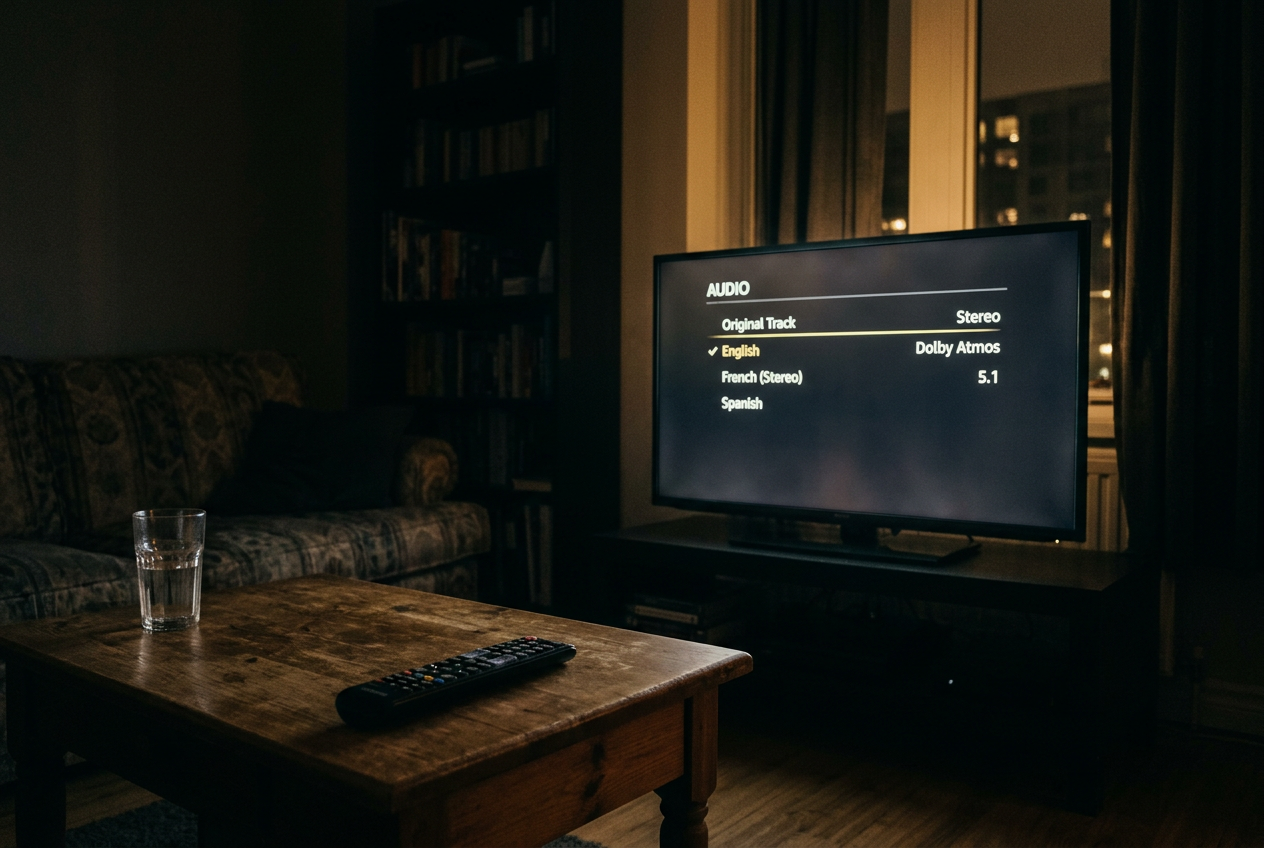
Choose the original audio track and the standard English subtitle track if the service and device offer both. Closed captions, meaning subtitles that also identify speakers and describe relevant sounds, remain the right accessibility option for viewers who need them, but a translation-focused subtitle track can place less text over scenes that already contain dense visual information.
Try the Episode 2 audience before committing. Watch from Blackthorne’s entrance through the first sustained exchange with Toranaga, then switch tracks and replay a few minutes. The comparison costs little time and exposes the whole tradeoff: subtitles ask the eye to move between faces and text, while the dub asks the mind to remember a language barrier the ear can no longer hear.
Reading speed matters. Anyone losing faces, gestures or spatial relationships while following subtitles may get more from the dub than from an original track they cannot comfortably process. The dubbed version is also a reasonable rewatch option once the alliances and language rules are familiar.
For a first viewing, though, the original track better preserves the series’ chosen structure. Shōgun does not treat interpretation as packaging around the dialogue. Interpretation is an action within the scene, and the Episode 2 audience works best when Toranaga, Blackthorne and Mariko do not merely look divided by language. They sound divided.
Questions people ask
Is Shōgun’s English dub easier to follow?
It removes most of the need to read translated Japanese dialogue, which can help viewers who struggle to divide attention between text and faces. It does not remove the need to track interpreters, speaker relationships and characters who cannot understand one another, so attentive viewing still matters.
Does the English dub change Shōgun’s story?
The main events and relationships remain legible. What changes is the delivery of information: characters who cannot understand each other may sound as if they share a language, leaving blocking, reaction shots and interpretation scenes to explain a barrier the original soundtrack makes immediately audible.
Which version is best for a first watch?
Original audio with English subtitles is the stronger first-watch choice because it preserves the Japanese-English contrast, the actors’ vocal timing and Mariko’s movement between linguistic spaces. Use the dub if subtitles keep pulling attention away from the image; comprehension is more valuable than maintaining a format that is not working for you.
Is the dub worth using for a rewatch?
Yes. Once the language rules and political relationships are familiar, the dub can free attention for costumes, blocking and background reactions. Revisit the Episode 2 audience on the original track, however, because its alternating voices make the interpreter’s pauses and each character’s limited knowledge easier to hear.
One update a day
Today's review, in your inbox
One review each morning — no hype, no filler, just what is worth watching.