
The Last of Us Season 2 Stops One Turn Too Early
Seven episodes sharpen Ellie’s grief but leave the season’s other perspective waiting offscreen. The result rewards close attention without providing much closure.
Streaming · August 11, 2026 · 7 min read
The shorter run changes the kind of commitment The Last of Us asks viewers to make. Seven episodes can fit into a weekend, and HBO’s weekly release is no longer a factor now that the full season is available, but the apparent convenience hides a larger obligation: this chapter ends by asking viewers to hold an interrupted confrontation until the continuation arrives.
That distinction matters more than episode count. Some short seasons feel complete because they concentrate a single movement. This one covers an inciting loss, Ellie and Dina’s pursuit through Seattle, and a gradual exposure of the damage Ellie carries, yet it withholds the perspective needed to finish the argument it has started.
The opening portion of this analysis is spoiler-safe. Detailed discussion of the final episodes begins below under a clear warning.
This belongs squarely to streaming coverage. The practical issue is whether HBO’s season gives home viewers enough shape for seven evenings, one concentrated weekend, or a subscription started specifically for this show. The answer depends less on patience with slow drama than on tolerance for a stopping point designed around future episodes.
A short season with an uneven clock
Season two moves quickly across geography and slowly inside memory. The route from Jackson to Seattle, which could have supplied hardship, bonding, and mounting unease, is largely reduced to transitions. Once Ellie and Dina reach the city, the series settles into longer scenes of searching, hiding, arguing, and processing what happened before they left.
That allocation is defensible. The Last of Us has never treated distance as the main attraction, and repeating the first season’s travel rhythm would make this chapter feel too familiar. The problem is that the show spends the time it saves without always increasing pressure. Seattle can feel strangely available to Ellie and Dina even as the wider conflict between the Washington Liberation Front and the Seraphites grows around them.
The middle episodes therefore alternate between intimacy and abbreviated danger. A subway escape or hospital pursuit can arrive with force, but the season often cuts away once a set piece has delivered its immediate result. The aftermath then migrates into another conversation, another location, or a later flashback. Momentum survives.
Accumulation is less reliable.
Bella Ramsey’s performance gives that broken rhythm a center. Ellie can still joke, flirt, and make an impulsive plan, while anger keeps changing the temperature of the scene underneath. Dina is more than a witness to that anger, and the season gives her enough agency to challenge Ellie’s decisions, though the compressed route means their relationship sometimes has to advance while plot information is also being exchanged.
For viewers deciding whether to start, this is the useful dividing line. The episodes work better when watched in pairs rather than consumed as one long feature, because their internal contrasts need a little space; the entire season in one sitting makes the skipped travel and rapidly changing threats easier to notice.
Spoilers begin with the final turn
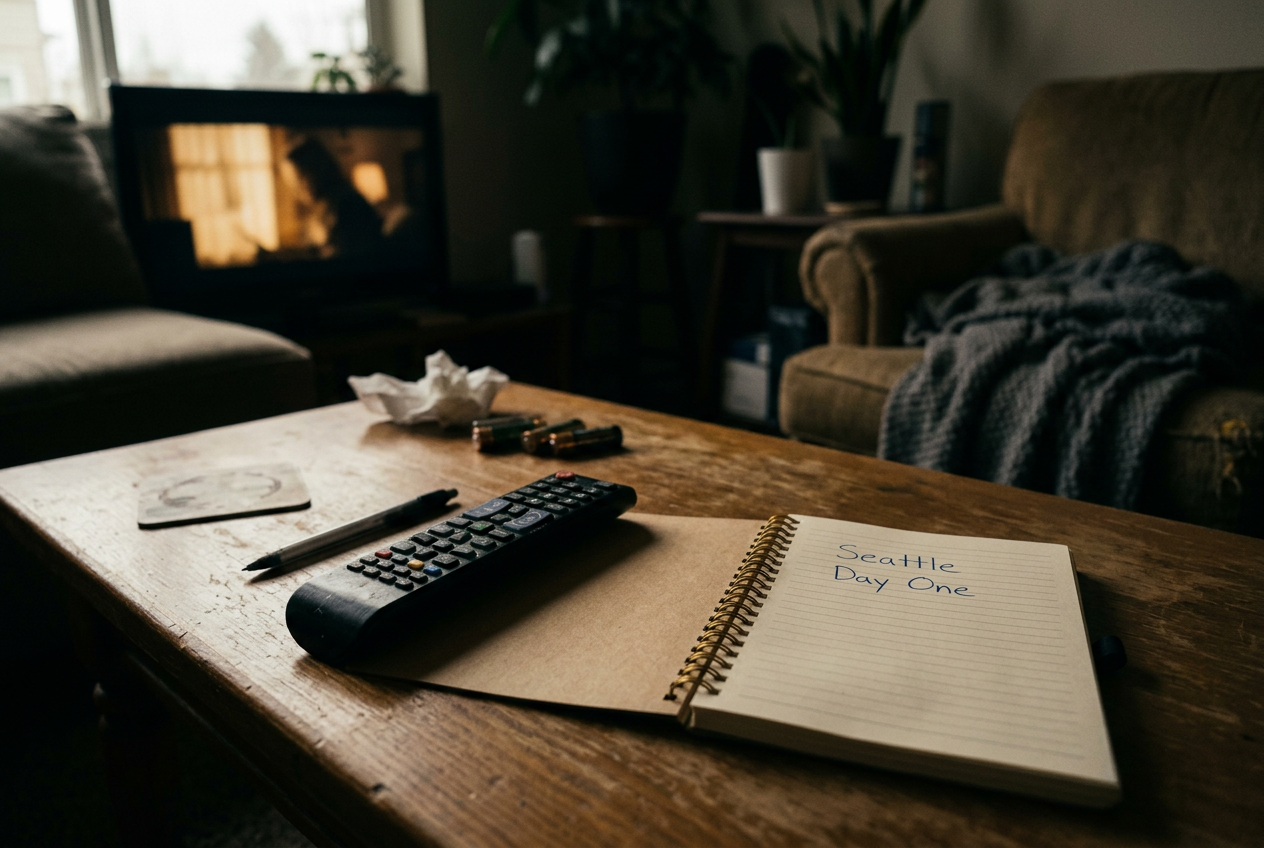
The season’s defining edit comes after the theater confrontation. Abby enters, the violence snaps several story lines together, and the scene cuts away before the encounter can reach a resolution. The clock then resets to “Seattle Day One,” with Abby awakening inside the WLF’s world.
That title card is the season’s real endpoint. It announces a point-of-view reset, meaning the story returns to an earlier moment through another character’s experience, rather than closing the conflict viewers have followed. The device comes directly from the broad architecture of The Last of Us Part II, where Ellie’s Seattle campaign gives way to Abby’s account of the same days.
In the game, that pivot is disruptive by design. Players have spent a much longer stretch controlling Ellie, searching spaces, surviving fights, and carrying out choices whose meaning changes once Abby becomes playable. Participation gives the reset weight. The player may resent Abby, but must still learn her movement, relationships, and daily obligations from inside her position.
Television cannot reproduce that transfer through control, so it needs another source of weight. Season two chooses delay. Abby appears around the central trauma, disappears for much of Ellie’s pursuit, then returns at the theater as both consequence and promise. Kaitlyn Dever’s limited screen time keeps Abby difficult to read, which protects the later reversal but leaves the finale dependent on material the season has declined to dramatize yet.
The “Seattle Day One” reset makes conceptual sense. As the final beat of a seven-episode television season, it feels like a withheld next episode.
Aftermath gets the time that travel loses
The season’s strongest allocation of time concerns Joel and Ellie. Rather than treating Joel’s death as an event to clear before the Seattle plot begins, the episodes let it alter the arrangement of the whole run. Joel remains present through Ellie’s habits, her refusals, and eventually the flashback structure of the sixth episode.
That episode moves through earlier points in their relationship, including the museum birthday trip and the difficult years that follow. Its placement is crucial. By delaying the fuller history of Ellie’s estrangement from Joel, the season allows her pursuit to look straightforward at first, then reveals that grief has attached itself to unresolved anger and a fragile attempt at reconciliation.
The porch conversation near the end of that episode carries more structural weight than any Seattle action sequence. Ellie cannot promise forgiveness, but she can imagine trying. Placed shortly before the theater confrontation, the scene clarifies why revenge has become such a consuming task: Ellie lost Joel just as their relationship might have changed.
This is where the shorter season earns some of its shape. A longer run could have scattered those flashbacks across several episodes, turning each into a regular interruption. Concentrating them lets the audience reassess Ellie at once, and Ramsey and Pedro Pascal have room to play the distance between affection and resentment without a parallel chase cutting in.
Still, the gain creates a visible tradeoff. Abby receives fragments while Joel receives an episode-sized return. Isaac and the factions fighting over Seattle receive enough attention to establish scale, but little of that material changes how the immediate pursuit is understood before the finale. The season knows whose grief it wants to inhabit.
It has postponed the test of whether viewers can inhabit the other side.
That makes the final “Seattle Day One” card more than a cliffhanger. A cliffhanger suspends an event. This reset suspends the season’s second argument, the one that must complicate everything already shown, and asks the continuation to supply both Abby’s interior life and the resolution of the theater scene.
The alternative was not more travel
Adding another episode of horseback travel would not fix the shape. Nor would extending every Seattle encounter. The cleanest alternative within a short season was one substantial Abby episode before the finale, enough to establish her daily life with the WLF and her relationships without revealing the full trajectory of her campaign.
That change would weaken the source game’s abrupt reversal. It would strengthen the television season. When Abby entered the theater, viewers would recognize a collision between two developed lines rather than the return of a character held outside the frame. The final reset could then promise a deeper account of familiar material instead of introducing the missing half of the structure.
A longer season offered another route: continue beyond “Seattle Day One” until Abby’s perspective had developed its own emotional direction. That would require several more episodes, because rushing her material into a single hour would reduce the point-of-view shift to explanation. HBO’s adaptation has chosen to split a dense game across seasons, but this particular dividing line favors fidelity to the game’s surprise over television closure.
The theater cut therefore keeps losing the thread at the same place. The episode has gathered Ellie, Dina, Jesse, Tommy, and Abby into one room under extreme pressure. Rather than let that pressure produce a season-sized consequence, it turns the page. The gesture is bold.
The wait remains the viewer’s problem.
Start now, wait, or return to the game
New viewers who value performance and character aftermath can start now, especially if unfinished serial drama is familiar territory. The season has individual episodes with clear dramatic identities, and the Joel-Ellie material reaches an emotional point even though the Seattle plot does not.
Anyone subscribing to HBO specifically for a complete movement should wait for the continuation. Seven episodes are easy to finish before a monthly subscription renews, but brevity is poor value when the final hour converts resolution into another future commitment. There is no need to keep paying between seasons solely to preserve momentum; the season itself does not provide that momentum past the cut.
Players who already know The Last of Us Part II have the strongest reason to watch now. The adaptation changes encounters, rearranges emphasis, and makes Ellie’s relationships work through performance rather than player action. Familiarity also removes the irritation of treating Abby’s reset as an unexplained destination.
Those who have never played Part II and want the complete architecture now should choose the game instead, provided they are comfortable learning the story through combat and exploration. It contains the perspective reversal and its consequences as one continuous work. Playing it will spoil the television continuation, but waiting for HBO means accepting that the theater confrontation may sit unresolved for a substantial stretch.
Season two earns its short run scene by scene more often than it earns the place where that run stops. The porch conversation gives Ellie’s grief a shape. The “Seattle Day One” card then hands the rest of that shape to another season.
Questions people ask
Is
The Last of Us season two worth starting now?
Yes for viewers who prioritize performances and do not need the Seattle conflict resolved this season. The seven episodes are manageable, and the Joel-Ellie material reaches a meaningful emotional point. Viewers who dislike perspective resets or long waits should hold off until the continuation is available.
Does season two cover all of The Last of Us Part II?
No. It adapts part of the game and stops as the narrative resets to Abby’s experience of Seattle. The game continues well beyond this point, giving Abby’s perspective enough time to challenge the assumptions built during Ellie’s campaign.
Should newcomers play the game before watching the continuation?
Play Part II first if a complete story matters more than avoiding television spoilers. Wait if discovering the adaptation’s turns through Bella Ramsey and Kaitlyn Dever is the priority, because the game reveals the perspective shift’s purpose and the later consequences of the theater confrontation.
Is one month of HBO enough for season two?
It is enough time to watch the full seven-episode run, particularly across a weekend or several paired evenings. The larger value question remains unresolved: subscribing only for this season buys a strong emotional chapter that stops before its central Seattle conflict pays off.
One update a day
Today's review, in your inbox
One review each morning — no hype, no filler, just what is worth watching.


