
ReelShort, DramaBox and GoodShort Dubs Need a Free-Episode Test
Headphones expose weak synchronization, while street noise buries inconsistent voices. Across all three apps, the safest choice is to test one free confrontation scene and keep subtitles on.
Streaming · August 11, 2026 · 7 min read
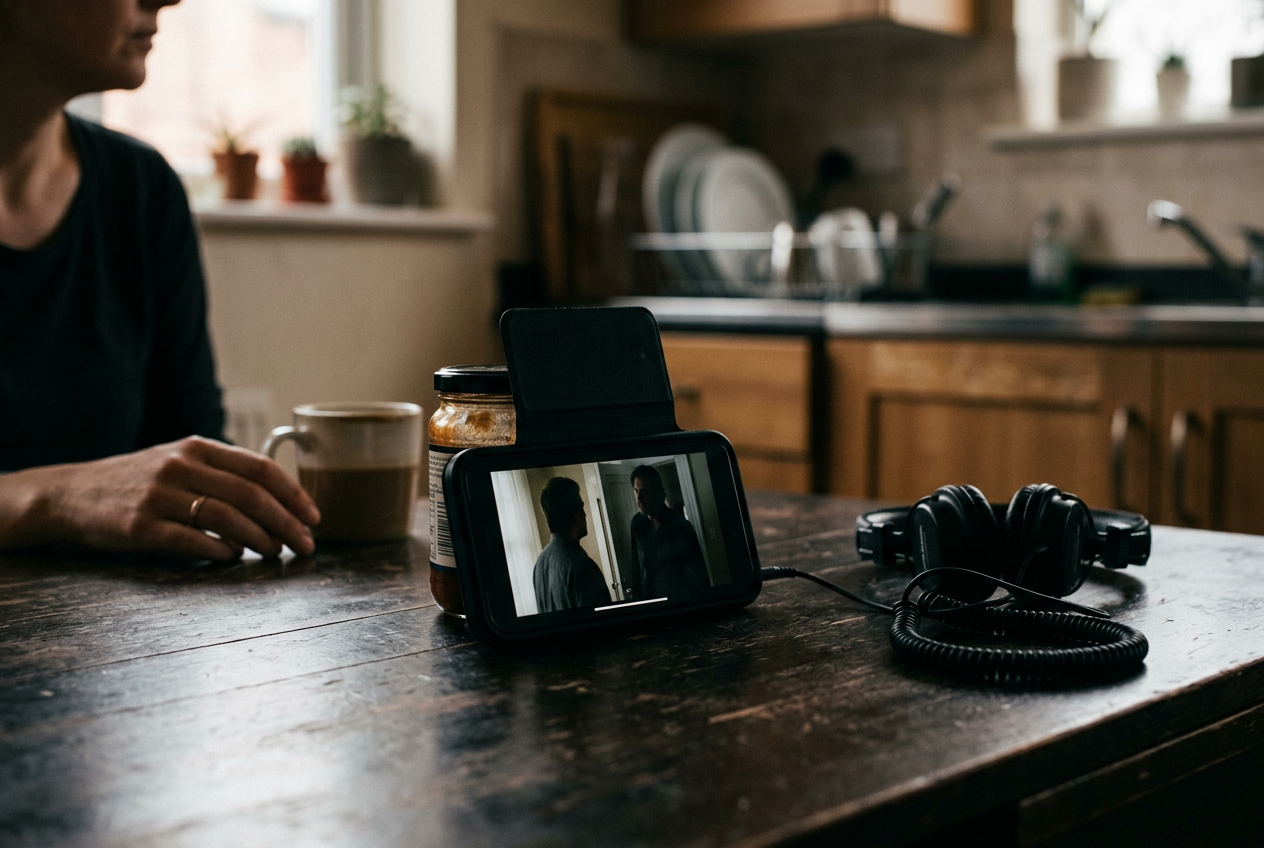
This is streaming coverage, specifically a guide to how micro-dramas behave on a phone rather than a ranking of their plots. It contains no story spoilers beyond the generic structure of an early confrontation.
The useful comparison begins with a doorway. Find a free episode in which one character enters a room, speaks before the cut, receives an answer from off-screen and reacts as the music rises. Micro-dramas, meaning vertical series told in one-to-two-minute episodes, use this construction constantly because it packs an arrival, a reversal and a cliffhanger into very little time.
That doorway confrontation also exposes almost every common dubbing weakness. Four checks matter: whether speech follows the visible mouth movement, whether a character keeps the same vocal weight from line to line, whether music leaves enough room for dialogue, and whether subtitles remain readable when the dub stops helping. Replay that short passage once through headphones and once with ordinary room noise. It costs less time than another episode and may save a purchase.
The awkward answer for anyone seeking a simple app winner is that ReelShort, DramaBox and GoodShort distribute many titles assembled through different production and localization pipelines. A polished dub in one series does not prove that the next title will behave the same way. The title is the meaningful unit of comparison; the logo is not.
Synchronization fails by degrees
Lip-sync is the alignment between spoken audio and visible mouth movement. Perfect alignment is an unrealistic standard for translated dialogue because an English sentence may need more or fewer syllables than the original line, yet the dub should still begin near the first visible word, respect pauses and finish before the shot has plainly moved on.
Return to the doorway test. The first line is easy if the speaker faces away from the camera. The reaction close-up is harder. When an English line continues after the actor's mouth closes, the performance feels detached, and headphones make that gap conspicuous because the voice arrives cleanly at both ears without the masking effect of traffic, conversation or a phone speaker.
Small mismatches are tolerable in a format that cuts rapidly. A late entrance is worse than an imperfect finish because viewers may briefly assign the line to the wrong person, especially when the speaking character is off-screen. If two people exchange accusations across several close-ups, repeated late starts turn a simple argument into clerical work.
None of the three apps should be treated as having one synchronization standard across every English title. That rules out choosing a subscription or coin bundle on the assumption that an app's first strong dub represents its catalog. Use free opening episodes to inspect the specific series, and test a scene with visible speech rather than a voice-over montage, where almost any dub can appear competent.
Voice consistency matters more than prestige
Vocal consistency means that a character sounds like the same person across adjacent lines and scenes. The problem is not merely a conspicuous actor change. Volume, microphone distance, accent and emotional pitch can shift within one exchange, leaving a whispery close-miked sentence beside a brighter line that sounds recorded in another room.
The doorway scene catches this quickly. Listen to the arriving character's first sentence, then the accusation delivered after the reaction cut. If the second line grows louder without the performance or camera position justifying it, the dub has made the edit visible. A one-minute episode cannot spare much attention for viewers to identify who is speaking again.
Casting also affects pace. Micro-drama dialogue often compresses family history, romantic betrayal and financial leverage into a handful of sentences, so a voice that stresses every revelation at maximum intensity flattens the sequence. The dub may be clear in the narrow sense that every word can be heard, while still making the cliffhanger harder to follow because no phrase receives useful emphasis.
This is where app-level comparisons become unreliable. ReelShort, DramaBox and GoodShort can each carry titles with different casts, recording conditions and translation choices. A familiar app interface cannot correct a voice track that changes texture between cuts. Keep paying only when the title you are following stays coherent through its free section and the first locked stretch, not because another series on the same service sounded better.
Headphones reveal the mix; noise defeats it
Background mixing determines how dialogue sits against music, effects and ambient sound. Ducking, the temporary lowering of background audio while someone speaks, matters more on a phone than it does through a television setup because tiny speakers have little room to separate competing sounds.
With headphones, listen at the moment the doorway confrontation turns into its cliffhanger. The music will usually rise before the final reaction or title card. A workable mix lets the last line remain intelligible without forcing the voice to jump sharply in volume. A weak one either buries the sentence or strips away so much background sound that the character seems to speak from a recording booth.
Room noise changes the judgment. On a train platform, in a kitchen or beside an air conditioner, music and effects are not the only competition; the listener also loses consonants, which carry much of the information in fast English dialogue. Turning up the volume can make the score harsher without restoring a softly delivered name or plot detail.
That makes the easiest app in noisy mobile settings whichever one, for the chosen title, keeps captions available and readable while English audio plays. Without current, title-level playback checks, a responsible comparison cannot crown ReelShort, DramaBox or GoodShort across its whole catalog. Controls and subtitle availability may also change by title, app version or device. Check before purchasing rather than assuming the option will remain present.
Subtitles are often the better localization
Subtitles are not merely emergency backup for a weak dub. They remove uncertainty when names, relationships and sums of money arrive faster than a translated performance can comfortably carry them. They also survive environmental noise without asking the phone speaker to overpower it.
Readability has its own failures. Captions need enough contrast against bright vertical footage, should avoid sitting under interface buttons, and must remain on-screen long enough to finish before the next cut. Translation timing matters too. If a subtitle reveals the final accusation before the actor delivers it, the text steals the episode's small cliffhanger; if it arrives after the reaction shot, the viewer has already missed the causal link.
Use the doorway test a third time with the sound low. The first subtitle should identify the entering character's statement before the response lands, while the final caption should clear before the app overlays its prompt or episode transition. If either line is obscured, moving to subtitles has exchanged an audio problem for an interface problem.
For quiet listening with good headphones, an adequate dub can preserve performance rhythm and let the viewer watch faces rather than read. In public or while doing anything that produces intermittent noise, subtitles usually provide the more dependable experience, even when the English track remains on at low volume. Muted viewing is harsher: captions must carry every relationship cue without help from vocal tone, and some compressed translations will sound more abrupt on the page than they do aloud.
A two-pass test before paying
Start with a free episode that contains direct conversation, not narration. Play the doorway-style exchange through headphones at a comfortable volume, watching for late line starts and shifts in vocal texture. Then replay it through the phone speaker with ordinary background noise and captions enabled.
Count four failures: a line assigned to the wrong visible speaker, a voice that changes recording character between cuts, music that hides a plot-bearing word, and a caption blocked or mistimed at the cliffhanger. One minor lip-sync miss is survivable. Two failures that alter who said what are a reason to continue with subtitles. Repeated caption problems make that specific title a poor purchase for noisy viewing, regardless of app.
This method also keeps the paywall in proportion. A micro-drama may ask for money one tiny episode at a time, but the audio decision can be made before the plot has accumulated enough momentum to excuse technical friction. Test the title, choose dub or subtitles, then decide whether its hooks deserve further attention.
Questions people ask
Which app is easiest to follow in a noisy place?
No platform-wide winner can be supported across ReelShort, DramaBox and GoodShort because dubbing and caption quality vary by title. The easiest choice is the app-title combination that allows simultaneous English audio and readable captions, without controls covering the final line. Check one free dialogue-heavy episode before unlocking more.
Are headphones better for dubbed micro-dramas?
Headphones make dialogue clearer and reduce the need to raise the volume, but they also reveal late synchronization, abrupt recording changes and aggressive music more readily. Use them for the first pass. If the dub remains coherent during a fast confrontation, it will usually require less effort than it did through the phone speaker.
When should
I switch from the English dub to subtitles?
Switch when late line starts make speakers hard to identify, when music repeatedly hides names or plot details, or when vocal inconsistency distracts from the cuts. Keep the dub quietly underneath if it helps with emotional tone. In intermittent public noise, captions should be the default rather than a rescue attempted after missing the cliffhanger.
Should one good dub influence which app I keep paying for?
Only for the title carrying that dub. ReelShort, DramaBox and GoodShort host series made and localized through varying pipelines, so one polished production does not establish a catalog-wide standard. Test the next series inside its free opening episodes, particularly the first visible argument, before treating previous audio quality as evidence.
One update a day
Today's review, in your inbox
One review each morning — no hype, no filler, just what is worth watching.


