
The Odyssey in IMAX 70mm Keeps More of Nolan’s Frame
IMAX 70mm can preserve a taller image and the texture of a large film print. Some IMAX screens keep only part of that benefit, so the theater listing matters more than the logo.
Cinema · August 11, 2026 · 8 min read
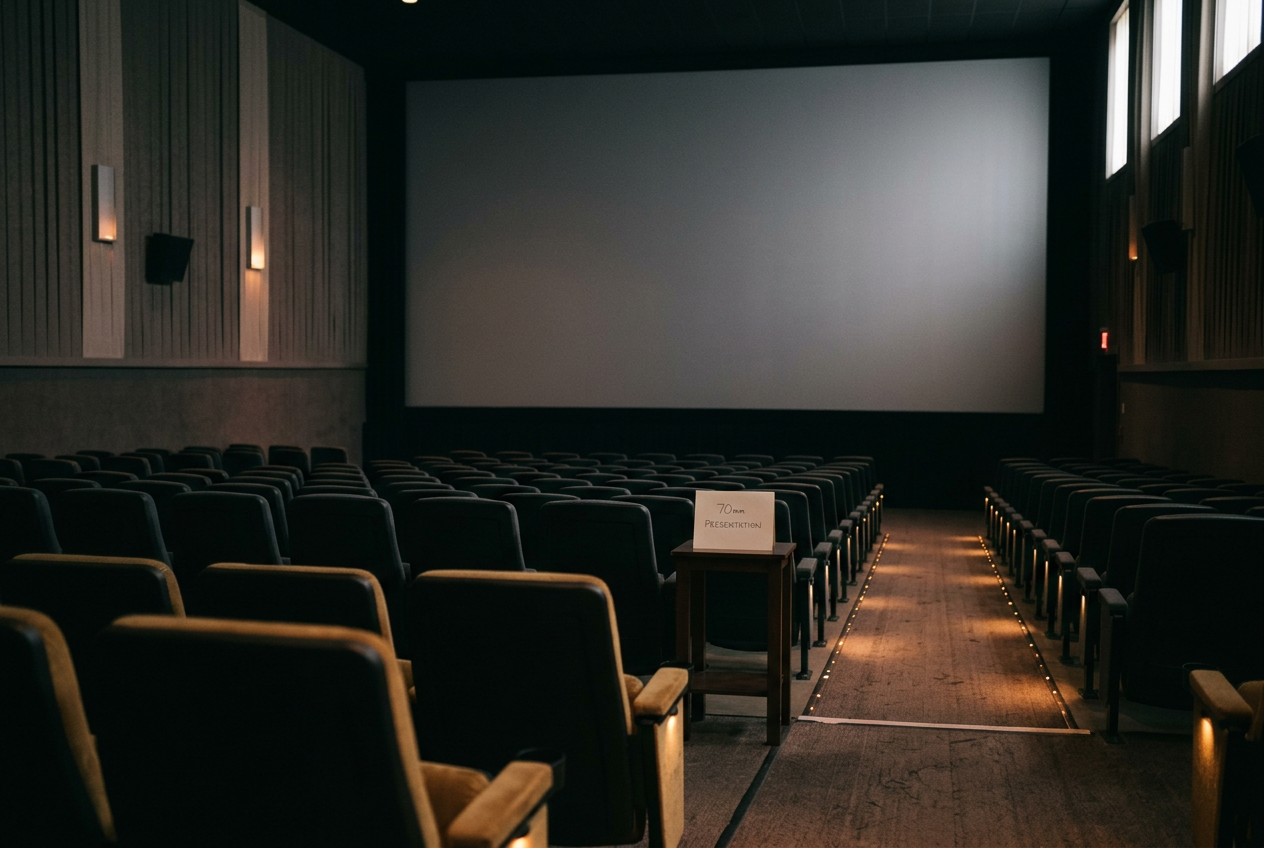
This is cinema coverage, and the useful decision comes before anyone can assess the finished film: Christopher Nolan’s The Odyssey was photographed entirely with IMAX film cameras, but that does not mean every theater carrying an IMAX surcharge will show the same amount of the image, through the same projection system, or on a screen shaped to use it.
Keep one illustrative composition in mind. Picture a ship deck running across the lower part of the frame, a standing figure near its center and a high column of sky above it. This is not a description of footage from the unreleased film. It is a practical test image for understanding what happens to a tall IMAX composition as it moves into shorter theatrical formats.
In a full-height IMAX presentation, the deck can sit low while the sky remains present, letting scale emerge from the distance between the figure and the upper edge. In a wider, shorter version, much of that sky disappears. The story information remains. The spatial pressure changes.
The taller frame is the main visible difference
Aspect ratio, meaning the relationship between an image’s width and height, determines how much of that illustrative ship shot can remain on screen. Full-height IMAX uses a 1.43:1 frame, which is much closer to a square than the wide rectangles associated with ordinary multiplex presentation. Many digital IMAX auditoriums top out at 1.
90:1, while conventional widescreen releases may be wider still.
The common shorthand says that IMAX “adds” picture at the top and bottom. That is useful, though incomplete. Nolan and cinematographer Hoyte van Hoytema can compose while seeing the tall capture area, then prepare alternate versions that protect the important action within shorter frames. The standard presentation is not necessarily a careless crop made by a theater employee.
It is generally a planned extraction from the larger photographed image.
Return to the ship deck. If the figure and horizon occupy the protected center, a 1.90 or conventional widescreen version can retain both while removing sky above and perhaps material below. No face needs to be cut off.
No plot clue must vanish. Yet the full-height version has more room to make the person look small against the environment, which matters for a story organized around travel, exposure and physical obstacles larger than its hero.
That distinction also explains why comparison images can mislead. A taller frame may contain more scenery without revealing more narrative information, while a tighter frame can sometimes direct attention more firmly toward an actor. More image is not an automatic improvement in every shot. It is a meaningful advantage when the composition uses vertical scale, bodies at different depths or movement that crosses the frame rather than sitting safely in its middle.
For The Odyssey, the premium case rests on how often Nolan uses that room, not merely on the camera named in the production announcement. The all-IMAX capture makes full-height composition available throughout the film. It does not prove that every minute needs it.
IMAX 70mm preserves film as well as height
IMAX 70mm, often written as 15/70, runs large-format film horizontally through a projector, with 15 perforations used for each frame. Conventional 70mm film usually travels vertically and uses a smaller image area, commonly presented around 2.20:1. Both can look excellent.
They are not interchangeable.
A genuine 15/70 IMAX print combines the 1.43 frame with the character of projected film: fine grain, slight movement from the mechanical transport and a bright image when the print and projector are maintained well. The large frame can hold considerable texture in faces, water, fabric and distant landscape without making the image feel electronically sharpened. Nolan’s format choice begins with capture, but a film print carries that physical chain into the auditorium.
Condition matters. A poorly aligned or dim film presentation can surrender advantages that exist on paper, while a well-calibrated digital screening can look cleaner and steadier. Film also acquires wear over a run. The 15/70 label describes the medium and frame capacity; it does not certify the projectionist’s focus or the lamp’s brightness.
The strongest digital alternative is a dual-laser IMAX theater equipped with a 1.43 screen and given a full-height version of the film. Laser projection uses digital light engines rather than a film print, and the dual-projector arrangement at suitable large venues can fill the tall frame. That presentation loses the specific texture and mechanics of film, but it can preserve the ship shot’s deck-to-sky geometry.
For viewers who primarily care about composition, that is the important part.
A digital cinema package, or DCP, is the file-based version delivered to a digital projector. It may reproduce a carefully graded image with stable brightness and no print wear, yet its aspect ratio still controls what can be shown. Digital does not inherently mean cropped. The auditorium, projector and supplied version decide.
The IMAX logo does not settle the format
Many IMAX auditoriums use a 1.90 screen rather than a 1.43 one. They may offer a larger image, stronger sound and better projection than a nearby standard room, but they cannot display the full height of a 1.
43 composition. On the illustrative ship deck, they preserve more sky than a very wide release might, though less than a full-height venue.
This is where premium branding stops being a reliable buying guide. A listing that says only “IMAX” may refer to 15/70 film, 1.43 dual laser or a 1.90 digital presentation.
Each can be worthwhile. Only the first two can preserve the tallest geometry, provided the venue receives and runs the corresponding version.
Conventional 70mm creates a different tradeoff. It gives the viewer a film print, often with attractive texture and strong color, but its wider frame cannot carry the complete 1.43 image. Someone choosing between 1.
90 digital IMAX and conventional 70mm is therefore choosing between extra vertical picture and a film presentation, not between a correct version and a defective one.
The price premium becomes harder to justify when the screen is modest, the seating distance makes it occupy little of the viewer’s vision, or the theater cannot identify its projection system. Enhanced sound and reserved seating may still have value, but neither restores missing frame height. Branding cannot put the sky back above that deck.
A practical order for buying a ticket
Start with the theater’s own format page rather than the ticketing app. Look for “IMAX 70mm,” “15/70” or an explicit statement that the screening uses film. If the listing says “70mm” without IMAX, treat it as conventional 70mm unless the venue clarifies otherwise.
If 15/70 is unavailable, check whether a nearby IMAX venue has a 1.43 screen and dual-laser projection. The screen’s shape can be a useful clue, but it is not enough on its own; a tall screen can receive a shorter presentation. Theater staff or a venue’s technical page should be able to identify the projector and advertised ratio once release specifications are confirmed.
A 1.90 laser IMAX screening comes next for viewers who want some expansion, a large screen and an IMAX sound mix without traveling far. Conventional 70mm becomes the more interesting alternative for viewers who favor film texture over maximum image height. Standard laser projection remains sensible when the nearest premium room offers no clear format advantage or charges mainly for the label.
Seat selection matters after format selection. A full-height frame asks the eye to travel upward and downward, so the front rows can turn added image into neck movement. Near the horizontal center and somewhat behind the auditorium’s midpoint is the safer choice in a steep, very large room. A perfect format from a punishing seat is a poor exchange.
The Odyssey may eventually have venue-specific presentation details that alter this order, and those details should outrank generic assumptions about Nolan releases. Until theaters publish them, the defensible advance choice is narrow: prioritize confirmed 1.43 capability, choose 15/70 when the film presentation itself matters to you, and do not pay solely because “IMAX” appears beside the showtime.
What disappears, and what does not
The shorter version loses photographed area, usually from above and below. It does not necessarily lose dialogue, intelligible action or the center of a composition, because alternate framing is prepared to keep those elements readable. Nolan’s films are released for ordinary auditoriums with the expectation that the story must function there.
What can disappear is the relationship between a body and the full environment around it. On the sample ship deck, the horizon still establishes the sea and the figure still anchors the scene, but reducing the sky makes the frame feel less vertically extended. That difference may last only seconds in an individual shot. Across a film built around landscapes, vessels and large physical sets, repeated reductions can change its visual rhythm.
The premium ticket buys access to those relationships. It does not buy extra plot.
Questions people ask
Is
IMAX 70mm the best format for The Odyssey?
On the available production information, 15/70 IMAX is the clearest choice for preserving both the tallest 1.43 compositions and a projected-film image. A well-run 1.43 dual-laser screening should preserve the frame height and may look steadier, making it the strongest substitute when film projection is unavailable.
Does every IMAX theater show the full 1.43 image?
No. Many IMAX auditoriums present images up to 1.90:1 and cannot display the complete height of a 1.43 frame.
Check the venue for a 1.43 screen and either 15/70 film or suitable dual-laser projection rather than relying on the IMAX label in a showtime listing.
Is regular 70mm better than digital IMAX?
It depends on the tradeoff. Conventional 70mm preserves a film-print character but generally uses a wider, shorter frame, while a 1.90 digital IMAX presentation may retain more vertical picture. Choose 70mm for the medium itself and 1.
90 IMAX for greater frame expansion, assuming both theaters project them well.
Will a standard screening make The Odyssey incomplete?
It should not make the story incomplete. Alternate framing protects central action and dialogue scenes for wider screens, though some photographed area will be absent. The practical loss is scale and compositional breathing room, particularly in images where a person, vessel or structure occupies only part of the full-height environment.
One update a day
Today's review, in your inbox
One review each morning — no hype, no filler, just what is worth watching.


