
F1 Loses Track Scale at Home. The Character Story Holds.
The Daytona opening explains why F1 benefits from a premium auditorium. At home, the cockpit footage survives better than the track geography, while the drama remains clear.
August 11, 2026 · 8 min read
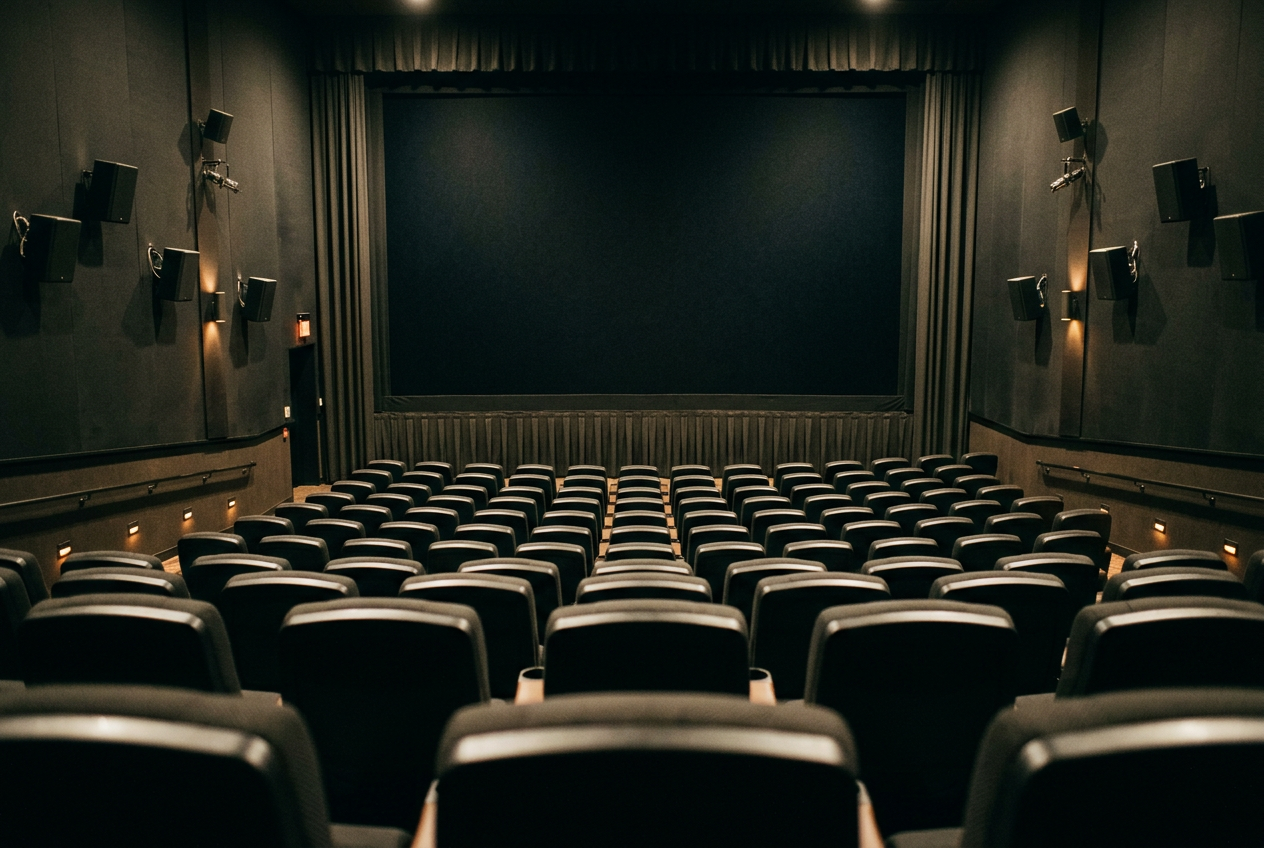
This analysis is spoiler-light. It names racing locations and discusses the construction of the final race, but it does not reveal results or late character decisions.
The useful comparison begins with the opening Daytona sequence, before F1 has established its Formula One team or asked the audience to invest in Sonny Hayes as anything more than a driver moving through the night. The sequence alternates between cockpit images, track views, pit activity and radio information, using the scale of the circuit to establish what Sonny can see and the sound field to suggest what he cannot. In a premium auditorium, the car occupies the room without always occupying the frame. At home, it occupies the television.
That distinction explains most of what changes after the premium theatrical window. The racing footage does not become illegible on a smaller screen, and some of the tight in-car material remains unusually effective, but the relationship between car, corner and surrounding traffic becomes harder to read when the image no longer extends into peripheral vision. Spatial clarity, meaning the viewer’s ability to locate a moving subject within its environment, is the first major loss.
This is cinema coverage that also serves at-home viewers, because the decision is no longer only whether to buy a ticket. It is whether to prioritize a premium screening before watching at home, and which compromises can be reduced once the film reaches a television.
Daytona establishes the format argument
The Daytona opening works as the article’s anchor because it separates two kinds of racing image that behave differently outside an auditorium. Tight cockpit shots retain speed through vibration, the driver’s limited sightline and the rapid movement of barriers near the edge of frame. Wider views depend on apparent distance: the car must look small enough for the track to feel large, while remaining easy to follow through darkness and lighting changes.
On a representative home setup, meaning a 55- to 65-inch 4K television viewed from a couch with a midrange soundbar and perhaps a subwoofer, those wide images lose authority first. The car remains visible, but the frame becomes information to inspect rather than space to enter. A viewer can still follow Sonny’s objective and understand the timing of the stint. The physical risk feels less immediate.
The cockpit perspective fares better. Because the camera is already confined by the car, shrinking the image does not contradict the shot’s basic design as severely as it does with a broad view of the circuit. The television can even make the driver’s face, steering inputs and mirrors feel more concentrated, provided the room is dim and the screen is large enough to dominate the immediate sightline. This is why F1 is not reduced to plot delivery at home.
Its strongest close racing images remain active.
Daytona also shows why screen size alone cannot settle the format choice. A large but dim auditorium with weak sound may offer less than a well-run standard screen, while IMAX, a premium large-format system built around an oversized image and high-output sound, is valuable here because the picture and audio enlarge the same piece of information. The car crosses the visual field as its engine moves through the room. Those cues reinforce each other.
The engine mix needs room around it
At home, engine sound tends to collapse toward the front of the room. A soundbar can produce width and some low-frequency weight, yet it cannot reliably place separate cars around the listener in the way a calibrated auditorium can, particularly when radio dialogue and music also occupy the mix. The result is louder sound without the same navigational value.
F1 uses engines as more than continuous force. Changes in pitch help mark acceleration and gear shifts, while differences in position distinguish the featured car from traffic that may sit beyond the center of the image. During the Daytona stint, the auditorium can make an approaching or passing car register before the viewer has fully identified it. Through television speakers, those layers are more likely to merge into a narrow, abrasive band.
Dynamic range, the distance between the quietest and loudest parts of a soundtrack, creates another home compromise. An auditorium can move from subdued dialogue or pit communication into the full pressure of a racing sequence without requiring the audience to manage the volume. At home, especially at night, viewers often lower the overall level, activate dialogue enhancement or enable subtitles. Each response solves one problem and changes another.
Subtitles keep radio instructions and quieter exchanges intelligible, but reading them during a race draws the eye toward the bottom of the frame at the moment the editing expects attention to move between mirrors, track edges and nearby cars. They are useful, not neutral. If dialogue is difficult to hear, a center-channel adjustment on a surround system or a restrained dialogue mode on a soundbar preserves more of the visual design than aggressive volume leveling, which can flatten the contrast between the garage and the circuit.
The large-track sequences lose more than the close calls
The races built around visible circuit geography carry the largest theatrical advantage. At Silverstone, the width of the track and the surrounding grandstands help the audience judge where a car sits before a maneuver develops. The Las Vegas material relies on illuminated distance and the separation of bright cars from a dense night background. The final race needs the viewer to track position through repeated shifts between cockpit, pit wall and broader circuit views.
These sequences remain comprehensible on television because the editing repeats essential information through radio calls, reaction shots and visible position changes. Comprehension is a low bar, though. The premium image lets a wide shot hold for a fraction longer in the viewer’s perception because the eye can search it without losing the featured car; on a smaller display, the same shot can feel like a bridge between close-ups rather than the main event.
The Daytona opening returns as the clearest demonstration. Its cockpit images survive reduction. Its track views do not fail, but they stop establishing the full distance between driver and destination. That loss matters more than extra sharpness.
A 4K television may resolve fine detail cleanly while still presenting the circuit at a visual angle too small to convey its scale.
A 70mm presentation, where available, should not be treated as an automatic upgrade over every IMAX screening. The term refers to the width of a film print, and it does not by itself guarantee the largest image, the strongest sound or the best-maintained room. For F1, the practical priority is a large, bright screen paired with forceful, well-calibrated audio. The venue matters more than the label alone.
The smaller screen exposes a conventional drama
Away from the circuit, F1 builds its character story around Sonny’s return, Joshua Pearce’s resistance to the veteran driver and team owner Ruben Cervantes’s need to make APXGP competitive. Kate McKenna’s engineering role gives strategy scenes a practical center, although the film still explains enough through dialogue that viewers do not need detailed knowledge of Formula One.
None of that requires auditorium scale. The smaller screen may even make the quieter exchanges easier to approach because faces and pauses replace the sensory pressure of the races. Brad Pitt’s restrained performance as Sonny depends on withholding rather than transformation, while Damson Idris gives Joshua’s frustration a directness that keeps their conflict readable when the spectacle recedes.
The limitation is structural. The drama often carries information toward the next race rather than opening a separate source of tension, so a home viewing makes the familiar shape more visible: setback, adjustment, renewed competition. Javier Bardem’s warmth as Ruben helps, and Kerry Condon gives Kate authority without turning every technical exchange into exposition, but the film’s persuasive power still rises when character choices become racing decisions.
That is why the final race loses less emotional meaning than physical scale. The viewer understands what Sonny and Joshua have placed at risk because the preceding drama has prepared it clearly. What diminishes is the sensation that those decisions must be executed inside a space larger and faster than either driver can control.
The practical viewing order
For a first viewing, choose a well-maintained IMAX auditorium or another premium large-format room with strong sound. Sit near the horizontal center and far enough back that the screen fills the view without forcing repeated head movement. Paying extra is easiest to justify for Daytona, Las Vegas and the final race, where image size and directional audio carry information rather than decoration.
At home, dim the room, disable motion smoothing and begin with the television’s cinema or filmmaker picture mode. Motion smoothing, which creates artificial frames between recorded ones, can make fast movement look unnaturally slick and can expose visual effects that the original presentation integrates more convincingly. Keep some low-frequency output if neighbors and timing permit, but prioritize clear dialogue over maximum bass.
The home version is adequate for a rewatch focused on Sonny, Joshua and Kate. It is also the sensible first option for viewers who are mainly interested in the cast and regard racing as narrative punctuation. Anyone drawn by the production’s access to Formula One circuits and cars should reverse that order. Watch large first.
The Daytona stint makes the reason visible before the main story has begun.
Questions people ask
Is
F1 worth an IMAX ticket if it is already available at home?
Yes, when the auditorium has a large, bright screen and properly calibrated sound. Daytona, Las Vegas and the final race use screen area and directional engine noise to clarify where cars sit on the circuit. A weak or inconvenient IMAX venue is not automatically preferable to a strong standard theater.
Does
F1 still work through television speakers?
The story remains understandable, but television speakers narrow the engine mix and can make radio dialogue compete with racing noise. Use a cinema picture mode, turn off motion smoothing and try restrained dialogue enhancement before enabling heavy volume leveling. Subtitles help, although they pull attention away from the lower part of fast-moving frames.
Which scenes lose the most on a smaller screen?
Wide circuit views lose more than cockpit shots. The Daytona opening, Silverstone’s track geography, the illuminated distance of Las Vegas and the final race all depend on seeing a car as one moving element inside a much larger space. Tight in-car footage retains speed and pressure more successfully.
Does the character story justify watching F1 at home?
Yes. Sonny and Joshua’s conflict, Ruben’s investment in APXGP and Kate’s strategic role remain clear without theatrical scale, even though the dramatic structure grows more conventional between races. For a rewatch, the television is enough. For a first encounter with the racing design, the premium auditorium comes first.
One update a day
Today's review, in your inbox
One review each morning — no hype, no filler, just what is worth watching.


